How One Silicon Valley Congressman is Trying Get AI Mega Money Out of Politics
Resumo
Um congressista de Silicon Valley recusa financiamento de super PAC ligado a OpenAI e outras big techs para evitar parecer capturado por interesses da indústria de IA em ano eleitoral.
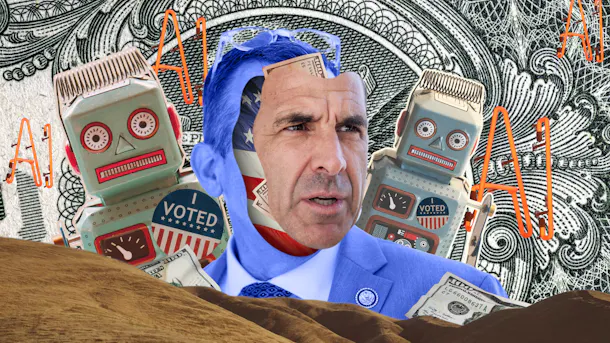
In early April, a staffer for Sam Liccardo, a freshman congressman representing the heart of Silicon Valley, got a call from a reporter telling them he was about to receive an endorsement—from Leading the Future, the $125 million political action committee funded by Andreessen Horowitz, OpenAI President Greg Brockman and Palantir billionaire Joe Lonsdale. It was the first Liccardo and his team had heard about the support.
Under normal circumstances, most political candidates would leap at the chance to have a deep-pocketed super PAC behind them, particularly one with Leading the Future’s pedigree. And after all, Liccardo’s district includes the headquarters of some of the world’s largest tech companies. But ahead of this year’s midterm elections, Leading the Future has become a poster child among politicians for the increasingly radioactive AI industry, whom voters are blaming for everything from job losses to rising electricity prices.
A Liccardo staffer texted Leading the Future that the campaign was fine with accepting an endorsement but added that it didn’t want the super PAC’s financial support. In an interview, Liccardo said he doesn’t have an issue with taking smaller sums of money from Silicon Valley donors. But he argues that deluging individual political races with millions of corporate dollars is repellent to voters, as well as many lawmakers.
Leading the Future, Liccardo said, is “not spending money in my race. So there’s nobody who can say, ‘Sam’s doing their bidding.’”
AI has rocketed to the top of voters’ concerns ahead of November’s elections. Scott Wiener, who helped craft sweeping AI regulation as a California state senator, said the technology became a leading conversation topic over the past few months as he ran in the Democratic primary for Nancy Pelosi’s congressional seat.
“There was a point where I was getting asked about AI more than I was being asked about Gaza,” he told me.
It hasn’t helped the public perception of AI that some of the tech industry’s wealthiest, most powerful figures have been pouring money into a bitter proxy battle between competing AI groups seeking to influence the upcoming election. On one side is Leading the Future, which favors a light approach to AI regulation and leaving it to the federal government, not the states, to develop those rules. On the other side is Public First, a $50 million super PAC network backed by OpenAI rival Anthropic that advocates for AI safety, export controls on advanced AI chips and protecting the rights of states to regulate the technology.
The most intense conflict between the two groups is a New York City congressional primary in which Leading the Future has spent over $6 million to defeat Alex Bores, a New York assembly member and former Palantir employee who sponsored one of the most stringent state AI laws in the country. In response, Public First has spent more than $4 million to help Bores’ campaign. Bores has decried the “oligarchs” of Andreessen Horowitz and OpenAI that are spending money against him, while his opponent, Micah Lasher, has accused Bores of accepting the funding of a different set of tech oligarchs.
Liccardo’s main issue with the PACs is tactical: He thinks the gusher of money they’re injecting into races is a turnoff for voters and does little to improve the narrative around AI. Otherwise, on the policy front, Liccardo has adopted a broad enough position to appeal to both groups. He’s moderate and pro-business, and he wants to protect state AI regulations while pushing for national uniformity in those rules. He believes data centers need to be built in a sustainable way and AI compute has to be accessible to universities through federal funding.
Others in Silicon Valley have begun echoing Liccardo’s view on the flood of tech cash into elections. In an opinion piece in The New York Times on Thursday, John O’Farrell, a former outside general partner at Andreessen Horowitz, argued that political spending by the AI industry will intensify backlash among voters.
“Huge political spending is toxic to our democracy,” he wrote. “It distorts the electoral process, and it won’t give the American people the thoughtful A.I. policy we deserve.”
Instead of accepting megadonations from AI companies and investors, Liccardo has embarked on what he hopes is a far less ostentatious effort to create bridges between the tech world and policymakers at a time when voter fears of AI are growing. He has formed a small PAC, Innovation for Good, that has brought Democrats from competitive districts nationwide to Silicon Valley to meet local tech donors and a hodgepodge of founders and venture capitalists—many of whom share views similar to those of the two super PACs but donate at several orders of magnitude less. He encourages the donors to give directly to the candidates, though they can contribute to the PAC as well.
Liccardo is able to help other Democrats in large part because he’s very likely to win his own reelection bid: He comes from one of the nation’s bluest districts, and he trounced his primary competition earlier this month.
So far, Liccardo’s PAC and fundraisers have raised around $1.1 million this cycle for other candidates, according to a staffer, with about $600,000 donated directly to candidates and nearly $500,000 coming from the PAC. That’s chump change compared to what the big AI PACs are spending, but he argues it helps foster connections between Silicon Valley and lawmakers with less intimidating dollar amounts while providing financing to close races.
“This is about winning Congress back, and that’s something that a lot of people in the Valley are very motivated by,” he said.
“I have no delusions about my ability to compete or scale on the order of what we’re seeing now with these large super PACs,” Liccardo said. “We’re not looking for any blind subservience to tech.”
Liccardo, who was formerly the mayor of San Jose, Calif., first won his Congress seat in fall 2024, around the same time tech was turning against the Biden administration. Prominent industry voices like Marc Andreessen, who had been major Democratic donors, began to shift rightward and complain about perceived slights from Biden deputies like the Federal Trade Commission’s Lina Khan and the Securities and Exchange Commission’s Gary Gensler.
When Liccardo got to Washington in early 2025, he said he met with House Minority Leader Hakeem Jeffries to raise concerns that Democrats were alienating a key base. That January, Jeffries and Liccardo hosted an event for around 150 Silicon Valley donors in Los Altos Hills, Calif., with Box CEO Aaron Levie, DocuSign CEO Allan Thygesen and other tech executives. (A Liccardo senior staffer said the goal of the event was to have a “listening session” for Jeffries.)
The gathering catalyzed Liccardo’s idea for the Innovation for Good PAC. He began to invite frontline Democrats—members of Congress in vulnerable districts across the country—to fundraisers in Silicon Valley where lawmakers could engage with local techies and avoid the missteps of the Biden administration. The events hosted about 50 donors and gave candidates an opportunity to raise about $50,000 each.
While Liccardo believes big money donations are polluting political races, he isn’t against taking smaller amounts of money from big tech for his PAC. The PAC is funded by a constellation of donors who work for companies like Google, Oracle and even OpenAI, who contribute anywhere from a few hundred dollars to the legal limit of $5,000, according to Federal Election Commission data. Some are executives and investors—Reid Hoffman pitched in $5,000, records show—but many hold more junior positions like software engineer.
In contrast, individual donations can donate as much as they like to super PACs like Leading the Future. (In turn, such organizations cannot donate directly to candidates or coordinate with campaigns but can spend an uncapped amount on advertisements for or against candidates and other expenditures.) Brockman and his wife, for example, have committed $50 million to Leading the Future, which has now raised a total of $140 million.
Innovation for Good’s structure as a PAC also means anyone can see the capital flowing into it and how it’s being spent. Both Leading the Future and Public First, in contrast, employ a web of dark-money organizations that obscure their money trails.
“Everybody knows where every dollar is coming from—and where it’s going,” Liccardo said.
Liccardo’s effort might have flown under the radar if not for the rise of Leading the Future. The super PAC was modeled on the crypto-funded super PAC Fairshake, which spent rampantly in the 2024 elections, helping unseat Ohio Sen. Sherrod Brown over his opposition to the industry. Leading the Future was the brainchild of Fairshake’s organizers, including Collin McCune, Andreessen Horowitz’s head of government affairs; Chris Lehane, OpenAI’s chief global affairs officer; and Josh Vlasto, a former aide to Andrew Cuomo.
The announcement of the group last August spurred Brad Carson, a former Democratic member of Congress who served as the Under Secretary of the Army under President Barack Obama, to form Public First, the Anthropic-backed PAC. He saw Public First as a way to counterbalance what he anticipated would be a soft-touch approach to AI regulations coming from Leading the Future. Carson has pledged to enter any competitive race that Leading the Future spends money on—which at the moment is the Bores campaign in New York.
“Our view was they were trying to basically buy the political process, and our job was to find money from whatever source we could to make sure that the democratic process remained open,” Carson told me. “We exist solely to thwart Leading the Future.”
Leading the Future did not make a representative available for an interview. “We will support policy makers and candidates who reject the extreme voices and want to engage thoughtfully and substantively on [AI regulatory] issues,” spokesperson Jesse Hunt said in a statement.
While media coverage often links Public First to Anthropic, Carson bristles at the idea of any influence from the AI giant. He says the AI company only came in with financial support after Public First had already raised $30 million. Anthropic pledged another $20 million but hasn’t been involved in the group’s plans. (OpenAI’s Lehane and Sam Altman have recently made their own statements distancing the startup from Leading the Future, despite Lehane’s role in creating it.)
Even if OpenAI and Anthropic aren’t participating in the political strategies of their respective super PACs, their mass donations certainly create the perception that they’re attempting to buy elections, according to Liccardo.
With the midterm elections approaching, Liccardo is thinking of expanding his Innovation for Good model to bring colleagues to other tech hubs across the country, either through his PAC or through their own fundraising organizations. “We saw too many folks in the tech community who were content to simply sit it out in the last cycle,” he said.
How durable the policy gap is between Leading the Future and Public First isn’t certain. Most candidates—and the vast majority of voters—argue that some form of regulation is necessary. OpenAI recently endorsed a bill in Illinois that would require AI companies to submit their model safety plans for third-party audits, and Anthropic backed limited preemption of state laws in a policy proposal released this week, though the two sides continue to argue over how much a federal framework should wash out local regulation.
“More and more Americans believe they are not part of a future in which AI takes a greater role, and that ultimately millions of Americans will be impoverished by this rather than enriched,” Liccardo said. “The industry’s got a lot of work to do.”