AI’s Blithe Spending and Crusoe’s Stargate Woes
Resumo
OpenAI e Anthropic fazem apostas bilionárias em infraestrutura de data centers para IA, enquanto o projeto Stargate da Crusoe enfrenta custos exponenciais de energia que o tornam insustentável no curto prazo.

Welcome, Weekenders! In this newsletter:
• The Big Read: Tech readies itself for a Reta-aissance
• Politics and Policy: A Silicon Valley politician’s counter move to the big tech PACs
• Biotech: Longevity startups’ holy grail pursuit faces a prosaic roadblock
• Plus, Recommendations—our weekly pop culture picks: “Last Resort,” “The Yahoo Boys” and “In the City”
Out in San Francisco, quite a few of you have commented on the amount of money New Yorkers have been forking over for Knicks seats. I agree—with excitement for the team as high it is, ticket prices have ricocheted off the backboard of normality.
But I gotta say: I’m surprised to hear all the hubbub from the West Coast about the cost of going to see the Knicks. After all, everybody in tech just keeps spending, spending, spending.
Of course, those dollars aren’t being spent on anything nearly as fun as sitting courtside with, you know, Michael Bloomberg. They’re going to AI. And just in the last several days, we’ve learned that OpenAI is in advanced talks to lease a gigantic Ohio data center that would total some 10 gigawatts and cost at least $500 billion, while Anthropic is making an expensive near-term gambit to lease its own data centers—a plan that may require Google as financial backstop—in an effort to lower compute costs in the future.
What’s happening with Crusoe, the data center developer behind the blockbuster Stargate project in west Texas, gives another sense of the exorbitant state of things.
In fact, I might just label Stargate a goddamn money pit. Crusoe CEO Chase Lochmiller himself recently admitted as much, saying gas power costs have almost tripled in recent years to roughly $3 billion per gigawatt. Meanwhile, Crusoe has needed to pause work on Stargate amid a slew of problems, including trouble with its turbines and back-and-forth conversations with the officials who control Texas’ energy grid.
Still, I get why Lochmiller and others in Silicon Valley aren’t slowing down. Investors are clearly in the mood to keep rewarding high spending and tall dreams. Case in point: the SpaceX IPO.
When the company’s shares finally made their Friday debut, they opened at $150 and ended the day up almost 20%. It’s too bad that investor sentiment can’t be turned into rocket fuel. That would surely make it cheaper for Elon Musk to actually get to Mars anytime soon. As it stands, internal projections of Goldman Sachs show SpaceX burning $350 billion in cash through 2030, and since Goldman helped tout the stock, I’d consider its figure on expenses a conservative estimate. Clearly, no one is in the mood for sobriety or relative ordinariness—and as a further indication, just look at Apple.
At the company’s developer’s conference on Monday, Apple detailed the upcoming updates to Siri that should greatly improve the AI, which, of course, has farcically been an industry laggard. None of what Apple showed off is at all wild, and the ploddingness dovetails with Apple’s parsimonious attitude toward AI, with the company spending far less on the technology than rivals like Google. After the Siri unveiling, investors spent the rest of the week selling off Apple stock, which finished Friday down 5.7% since Monday. (And yes, surely some of the selling came from lingering doubts about whether Apple has finally gotten it right with Siri—as well as other people taking profits from a recent run-up in Apple stock.)
So I fully expect the rampant AI spending to continue. And honestly, the mindset behind it seems quite like the one apparently pushing the technorati to buy up unregulated, bootleg versions of an unapproved peptide, retatrutide, which purportedly is far more potent than other such drugs: a staggering belief that nothing bad could ever possibly happen.
Yet as, say, the San Antonio Spurs can attest, misfortune can arrive with swift surprise.—Abram Brown (abe@theinformation.com)
Weekend’s Latest Stories

Inside Tech’s Feverish Demand for Retatrutide, a Supposed Super Peptide
Retatrutide hasn’t yet received FDA approval. But tech executives have already embraced a Wild West market for bootleg versions.
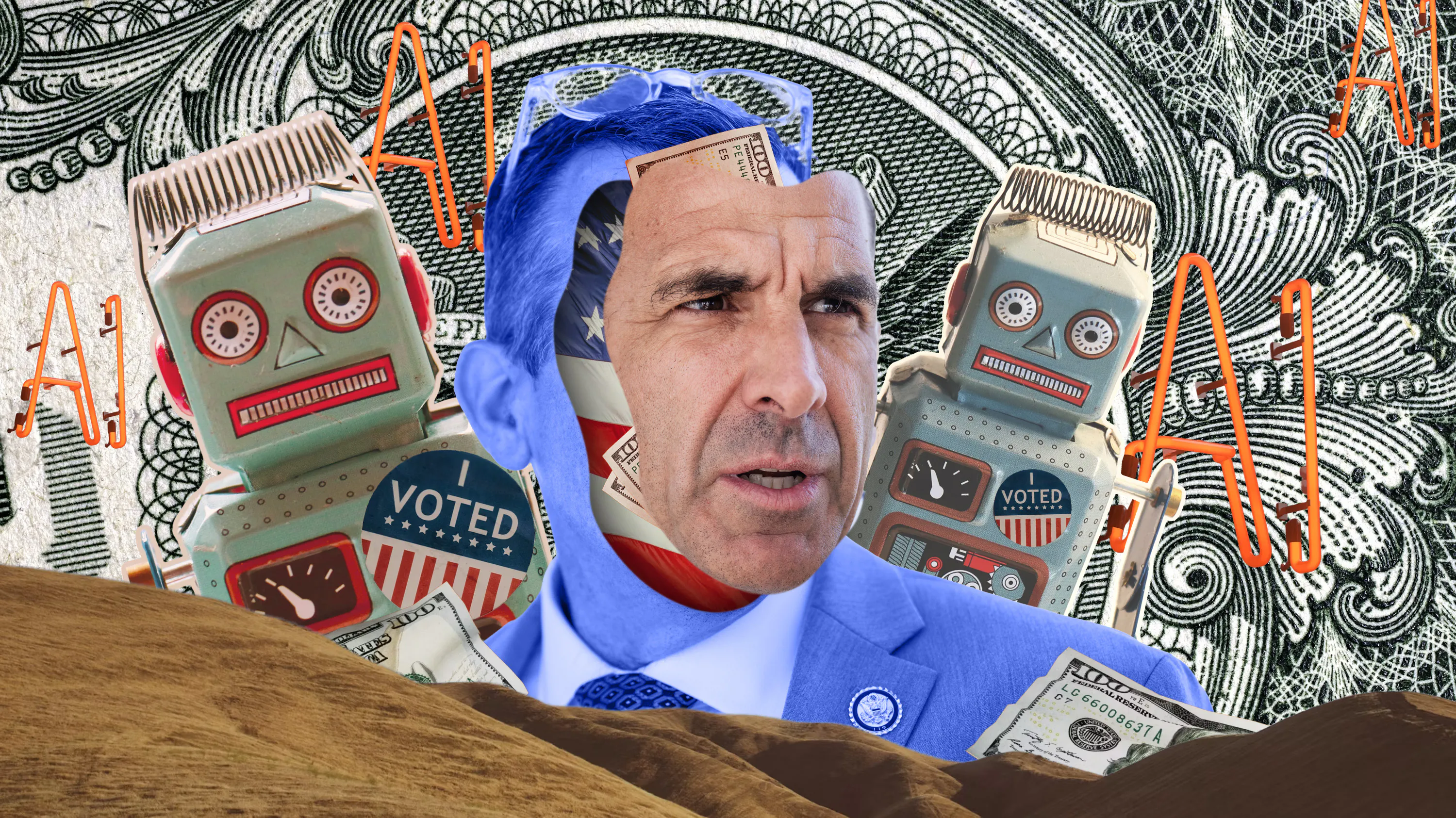
The Silicon Valley Congressman Who Wants to Cut Off AI’s Mega Political Spending
Sam Liccardo, a California Democrat, has a plan to help his party evade the pull of the “oligarch” super PACs—while also supporting tech growth.

Longevity Startups Have a Conundrum: Can They Sell Longevity Drugs?
The companies are engaged in a holy grail pursuit to reverse aging. For now, their plans are much more prosaic.

Listening: “Last Resort”
The concept of a stealth startup certainly appeals to Jonah and Phyllis Beveridge, who picked a helluva headquarters for Ichos, their wellness tech company: a remote island somewhere in the Atlantic Ocean, the setting of this fictional series. (As they point out, who needs formal security measures when the entire place is ringed by a deadly array of rocks?) The Beveridges have labored in secret to develop an AI that dispenses sound-based behavioral therapy, and they’re keen to test it on a group of unlovables, including caustic, combative Nikki, a canceled influencer. “Last Resort” is a black comedy, a balm for the itch left by a long absence of fresh “Black Mirror” episodes: When Nikki makes an analogy between Ichos’ AI and Apple’s Siri, Phyllis’ hackles go up, and she worries Nikki might make the same remark to her thin-skinned husband. “Don’t use the S-word around Jonah,” she says. “Sensitive subject.”—Abram Brown
Reading: “The Yahoo Boys” by Carlos Barragán
Nigeria is an impoverished country that for decades has seemed to exist on the cusp of greater prosperity. If only the nation could find better use for the entrepreneurial ingenuity displayed by an ever-growing network of young internet con men, the place might rival Dubai overnight.
Carlos Barragán, a New York Times reporter, set out to learn more about the schemes and subculture behind this loosely connected mafia, the Yahoo Boys—the earliest members liked using Yahoo.com emails—after one almost snookered his mother. The near miss took Barragán by surprise: His mother, a Madrid dentist, wasn’t an uneducated fool. But she was divorced and living alone—so she was lonely, which made her vulnerable enough for a Yahoo Boy to pull the wool over her eyes by posing as Brian, an attractive, middle-aged American soldier. They’d met over Tinder, and such rackets involving a fake online romance are a favorite of the Yahoo Boys. Barragán managed to expose the crook to his mother before she lost any money. Many other people targeted by the Yahoo Boys aren’t so fortunate.
Barragán’s expedition takes him to Lagos, Nigeria’s teeming metropolis of nearly 20 million people. He partly goes to find the Yahoo Boy who tricked his mother, but once there, his local fixer likens such a quest to finding a needle in a haystack—so plentiful have the Yahoo Boys grown. He meets many other Yahoo Boys and emerges with a colorful, uncomfortable portrait of modern times: The loneliness epidemic that has intensified among Westerners who live increasingly online—detached from real-world interactions—puts them at growing risk of succumbing to internet-based schemes offering any sort of intimacy. In the developing world, dire economics push young people toward groups like the Yahoo Boys.
In Nigeria, the Yahoo Boys present a mass-scale problem. One Yahoo Boy, who initially began scamming to afford college but dropped out to better enjoy his windfall, told Barragán that 80% of the other young men in his college class have been involved in online scams.—A.B.
Watching: “In the City”
Much has been happening lately on “Summer House,” a Bravo reality show that follows a group of New Yorkers and their drama as they share a Hamptons rental house. The cast has been rocked this year by the revelation that two of the show’s stars—West Wilson and Amanda Batula—secretly started dating, scarcely a moment after Batula and another castmate, Kyle Cooke, had announced their divorce.
Wait, wait—there’s more. As in another Bravo show: “In the City,” which picks up where the most recent “Summer House” season left off. As with all great reality TV, the delight of “In the City” lies in the varied cast and their antics. “In the City” follows Batula, Cooke and other “Summer House” regulars as they busily try to reacclimate to life in the big city and some substantial changes in their lives, like new babies, apartments and relationships. One cast member, Kenny Martin, describes himself as a venture capitalist: He’s invested in Cooke’s brand, Loverboy, a line of hard seltzers and canned cocktails that launched in 2018. In another corporate-minded plotline, the show highlights Cooke’s ups and downs as he tries to scale up Loverboy and manage the company’s cash flow issues. America’s recent shift away from alcohol consumption might not be good for Cooke, but it’s great for Summer House cast member and In the City guest star Carl Radke, whose Brooklyn watering hole, Soft Bar, focuses on mocktails and nonalcoholic drinks. Like I said, they’re quite an assorted bunch.
You don’t need much of the “Summer House” backstory to enjoy “In the City,” and Bravo really does make for the perfect summer viewing fare. So—see you at Soft Bar!—Ann Gehan