Server Networking Boom Drives $300 Million Funding For Xsight
Resumo
Xsight, startup israelense de chips de rede para servidores, levantou $300 milhões em Series C a avaliação de $2,8 bilhões; a empresa fabrica switches Ethernet e unidades de processamento de dados que conectam GPUs e armazenamento em data centers, num mercado que Goldman Sachs estima crescer de $15 bilhões em 2024 para $150 bilhões em 2028.
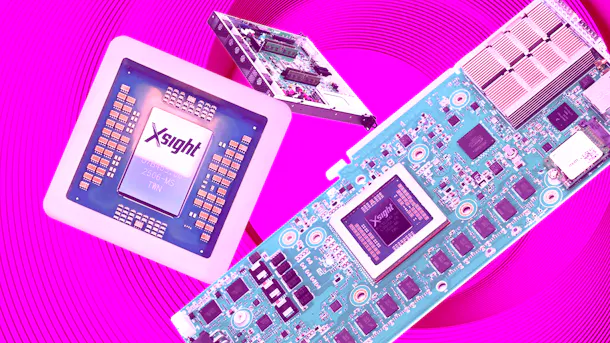
Graphics processing units are all the rage, but startups developing the networking equipment that connects GPUs to one other are getting some love from investors, too. The latest is Xsight, a nine-year-old startup based in Israel that makes server networking and storage chips, the latter of which are also in high demand in the current boom.
Five years after its last major fundraising, Xsight has raised $300 million at a $2.8 billion valuation, the company told The Information exclusively. The fundraising round was led by Fidelity Investments, the mutual fund giant. Gavin Baker’s Atreides Management, a longtime AI hardware investor and former Fidelity portfolio manager, as well as Valor Equity Partners, Battery Ventures and Intel Capital also participated.
The deal follows fundraising in the past month by networking startups Eliyan and Upscale AI, which notched $1 billion and $2 billion valuations, respectively.
Dependable networking is crucial to running bigger AI models fast, and the world’s biggest AI chip designers are selling ever-greater amounts of such equipment. AI data center networking revenue could grow from $15 billion this year to $150 billion by 2028, Goldman Sachs estimates. Broadcom, along with Nvidia and Marvell, dominate the networking market while AMD, Intel as well as Nvidia have a stronghold on selling storage hardware for AI chip servers.
Xsight makes Ethernet networking switches that connect server racks to each other and storage cards, known as data processing units, that move data between GPUs and storage drives. Xsight’s pitch is that its hardware is extremely programmable, meaning customers can write software to change what kind of work it can do.
“At the same time, we do not sacrifice on power, and we do not sacrifice on cost,” CEO Yossi Meyouhas said.
After a quiet last few years (which included a reported round of layoffs), Meyouhas said the company raised funding to scale production. In December, Xsight said SpaceX plans to use its networking switches in the current generation of Starlink satellites. Outer space is a natural fit for Xsight because once the hardware is sent to space, you can’t go up there and fix it; but you can change the software from a computer on Earth.
Xsight’s goal is eventually to get the switches in large data centers on earth that SpaceX is building. Xsight would no doubt face lots of competition, including from Nvidia, which sells full server racks that include networking and storage hardware. (Fidelity, Atreides and Valor are also SpaceX investors.)
Xsight declined to disclose its revenue, though Meyouhas said the company has shipped a few thousand each of its networking and storage products.
One potential advantage is Xsight’s relationship with Taiwan Semiconductor Manufacturing Co., which stems from Xsight Chairman Avigdor Willenz’s longtime connection with the chipmaker, according to an Xsight investor. (Willenz founded networking silicon company Galileo Technologies and sold it to Marvell in 2001 for $2.7 billion. He was also a founding investor in Trainium chip designer Annapurna Labs, which Amazon acquired.)
A direct TSMC relationship is somewhat unusual for a relatively small startup, as even big chip developers like Google go through intermediaries like Broadcom to deal with TSMC.
“Avigdor’s companies are better at getting allocations [from TSMC] than any other private semiconductor companies I’m aware of,” the investor said.
Here’s what else is going on…
People on the Move
Lilian Weng, a researcher who cofounded AI startup Thinking Machines Lab alongside former OpenAI Chief Technology Officer Mira Murati, is rejoining OpenAI after announcing her departure from Thinking Machines earlier this week, an OpenAI spokesperson confirmed to The Information.
Swami Sivasubramanian, vice president of agentic AI at Amazon Web Services, is taking on an expanded role that involves serving as a “strategic advisor” to other internal teams developing AI products, CEO Matt Garman announced in an email to employees.
Overheard
OpenAI’s revenue growth has accelerated this month compared to the second quarter of this year, Chief Financial Officer Sarah Friar told employees on Wednesday, as the company tries to close the distance with rival Anthropic. OpenAI in July added more annualized revenue—a measure of monthly sales times 12—than the increase in that figure over the previous three months combined, The Information reported.
Meanwhile, OpenAI CEO Sam Altman said on a podcast this week that the company “paused training” following a recent incident in which an AI agent the company developed went rogue and hacked into the systems of AI model repository Hugging Face.
Earnings Report
Microsoft revenue rose 18% to $90 billion in the June quarter, the same growth rate it reported in the first quarter, according to its quarterly earnings report.
Meta Platforms’ operating profit fell 8% in the second quarter, despite 28% revenue growth, reflecting a sharp increase in costs relating to Meta’s AI investments and some one-time costs.
Policy Watch
A group of U.S. senators are urging Apple to drop any plans to buy memory chips from Chinese suppliers ChangXin Memory Technologies and Yangtze Memory Technologies, citing national security risks, Bloomberg reported.
Deals and Debuts
See The Information’s Generative AI Database for an exclusive list of private companies and their investors.
Moonshot AI, the startup behind the Kimi family of AI models, has closed a $3.5 billion funding round and is preparing for a Hong Kong initial public offering as soon as 2026, Bloomberg reported.
Nscale, a cloud provider, agreed to acquire inference provider Anyscale for around $1.65 billion, Bloomberg reported.
Simile, an AI simulation company, raised a $200 million Series B round at a $2 billion valuation led by Greenoaks Capital.
Eliyan, a company that allows chips inside an AI system to talk to one another quickly and efficiently, raised $145 million in a Series C funding round led by Seligman Ventures.
Onyx Security, a company that helps businesses discover and control how employees and software are using advanced AI inside their organizations, raised $113 million in a Series B funding round led by Bessemer Venture Partners.
groundcover, which makes monitoring software that lets companies watch how their applications are performing and where they're breaking, raised $100 million in a Series C funding round led by One Peak.
ChipAgents, which uses AI agents to automate the designing and testing of computer chips, raised an additional $60 million in a Series A2 funding round led by new investor B Capital.
Encore AI, which provides AI agents that handle customer phone calls and other interactions, raised $30 million in a Series A funding round led by Team8, Planven and The Garage.
Agon, a startup developing computing infrastructure to train AI models specifically for European defense, emerged from stealth with $30 million in funding from investors including Lakestar, Lux Capital, Northzone and XYZ.
Henry AI, a New York City-based startup that automates back-office work for commercial real estate teams, raised $16.5 million in Series A funding led by FirstMark Capital.
Dili, an AI compliance startup, raised $15 million in Series A funding led by Khosla Ventures.
Hint, which offers an AI assistant for homeowners, raised $10 million in funding from investors including Montauk Capital, Brian Kelly, Slow Ventures, Tusk Venture Partners, Energy Impact Partners, Amplo VC and Hannah Grey.
Polar, which offers an AI browser aimed at knowledge workers, raised a $5.7 million seed round led by Madrona.
AI coding startup Replit announced Replit Design, a new AI-powered tool for designers.
MinIO, the startup that helps AI memorize and retain context for enterprises, announced AIStor Memory, a product that provides AI agents with a durable environment to store their memory workspace, and secrets in an integrated system.
New From Our Reporters


Nvidia Bet on Reflection for Open-Source AI. Now the Startup Is Playing Catch-Up.
Recommended Newsletter
Stay ahead of the AI infrastructure wars. Ann Davis Vaughan covers how tech titans are disrupting the energy sector and becoming accidental industrial giants to compete on the AI model battlefield. Subscribe to AI Infrastructure.
What We’re Reading
Upcoming Events
Wednesday, September 23 — AI Agenda Live SF 2026
Get ahead of the story. Purchase your ticket to AI Agenda Live, where The Information's reporting team convenes the leaders driving the next era of AI. Early Access pricing ends on 7/31.
More detailsTuesday, October 27 — The Information’s 2026 WTF Summit
Tickets on sale now: The Information returns to Napa Valley October 27–28 to convene senior women across tech, media, and finance. Join us for two days of intimate, candid conversations with the leaders navigating today’s global shifts.
More detailsThank you for reading the AI Agenda Newsletter! I’d love your feedback, ideas and tips: stephanie@theinformation.com.
If you think someone else might enjoy this newsletter, please pass it forward or they can sign up here.