Exclusive: Data Center Costs Set to Rise as U.S. States Move to Repeal Tax Breaks
Resumo
Vários estados americanos estão revogando ou pausando incentivos fiscais para data centers de IA, com potencial aumento de 7% ou mais nos custos de equipamentos; governadores argumentam que os subsídios anteriores foram excessivos e agora prejudicam receitas estaduais, enquanto algumas jurisdições discutem endurecer requisitos para concessão de benefícios.
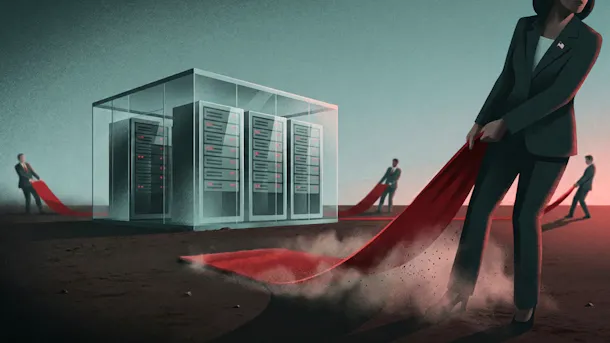
Governors and legislatures in U.S. states that previously welcomed data centers are suddenly moving to rip away sales tax breaks that could raise the price of every gigawatt of AI computing by several billion dollars, potentially adding 7% or more to equipment costs.
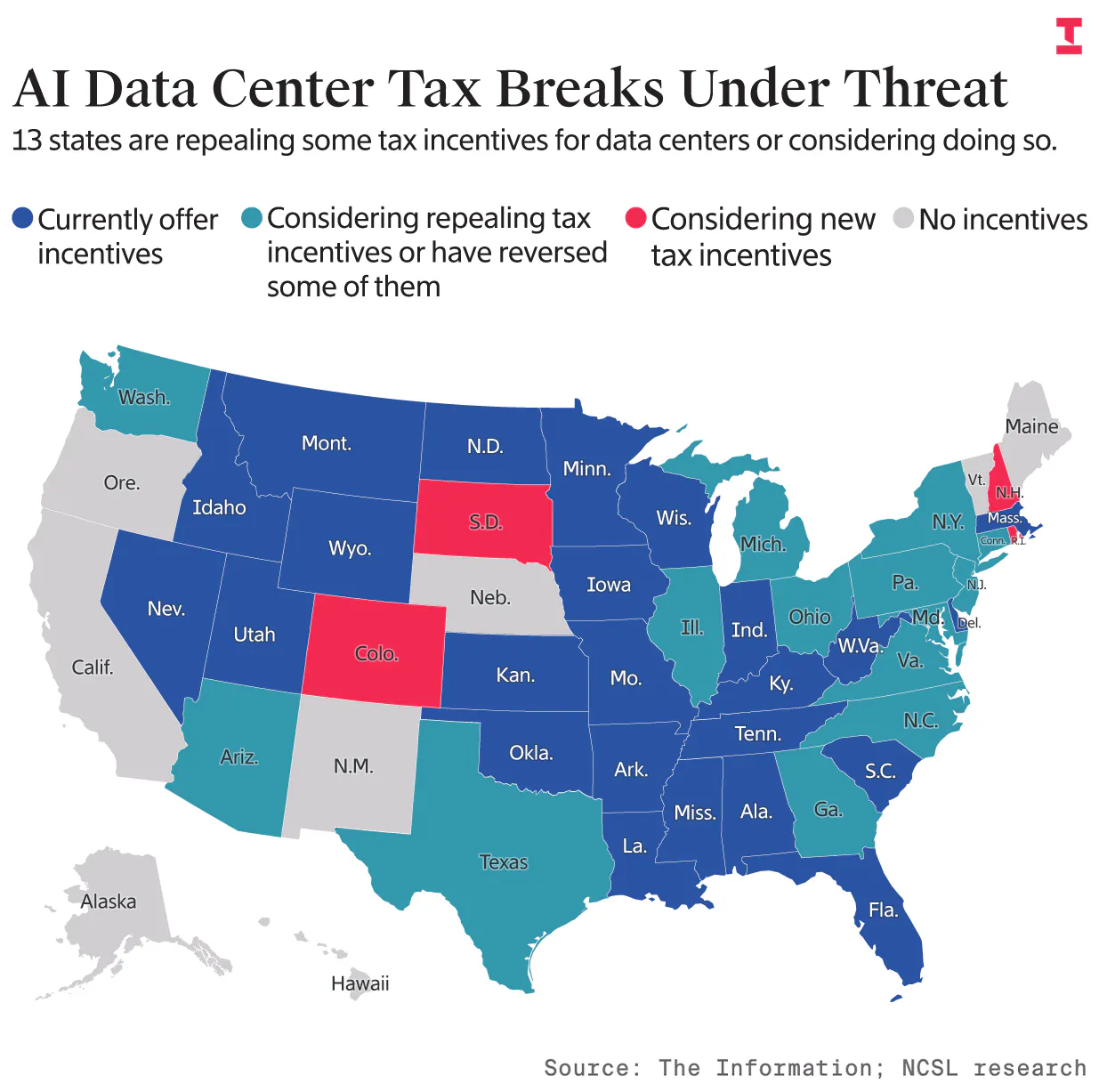
In little-noticed moves that sharply accelerated this summer, four states rolled back or paused data center tax incentives, while officials in nine other states are considering repeal measures, according to the National Conference of State Legislatures, an advocacy and research association for state lawmakers, and The Information’s analysis.
The reason is simple: Governors and lawmakers from both parties are defending themselves from charges that they gave away too much when they vied to attract Microsoft, Google, Meta Platforms, Amazon, Oracle and others earlier in the boom. Now the officials say the tax breaks are depriving them of revenue and may no longer be needed to attract business.
Instead of just rolling back all tax breaks, some states could end up stiffening requirements for tech firms to win exemptions: for example, by requiring that they guarantee a certain number of new jobs or help pay for public infrastructure. And local authorities could still give city or county-level property tax abatements, with similar conditions, to attract development.
Tax-break repeals are one of a growing list of factors raising the costs of AI data centers. Tech firms are paying a lot more than they bargained for to generate the power they need and fortify infrastructure ranging from water to transmission lines. In many states, they are also scrambling to install new equipment to satisfy power regulators’ demands that the facilities won’t harm or overload grid equipment. Each new expense cuts into the profit margins for tech and data center firms.
Lately these concerns have impacted the financial terms of some debt deals for data centers.
Repeals of sales tax exemptions on chips and server purchases could hit the tech industry especially hard. Tech firms had been depending on them to make their projects pencil out. In many cases, such as Meta’s move to build a multi-gigawatt site in Louisiana, companies wouldn’t commit to projects until states passed such exemptions. That’s because IT equipment is by far the single biggest expense for an AI data center, and operators expect to replace the chips every five or so years. As we’ve reported, a gigawatt-scale campus requires roughly $40 billion in IT equipment, compared with $19 billion for the land, facilities, non-IT equipment and on-site power that might supplement or replace a grid connection. (A gigawatt is enough power for a medium-size city like Denver.)
In a state imposing, say, a 7% state sales tax, that $40 billion expense per gigawatt could grow by nearly $3 billion a gigawatt to roughly $43 billion.
The biggest new threat is in Texas, which is supposed to dethrone Virginia as the world’s largest data center market in power capacity by 2030, according to JLL. After holding a celebratory groundbreaking with Google CEO Sundar Pichai last year, Gov. Greg Abbott in June suddenly directed the Texas Legislature in its next session to “repeal sales tax exemptions and other outdated or unnecessary incentives for data centers.”
That’s a big deal, because tens of gigawatts of AI campuses are already underway or announced in the Lone Star State, and the grid operator there has received requests to connect hundreds of gigawatts more. Dan Diorio, executive vice president of state policy and government affairs for the Data Center Coalition, an advocacy group representing major tech and data center firms, rushed to a hearing in Austin, Texas, last week, trying to save the tax benefits, which have been in place since 2013. The Legislature is due to take up the issue when it reconvenes in 2027.
“If those go away or are yanked all of a sudden, your entire business plan is in flux,” said Diorio.
Other states have been following suit. Washington state, home of Amazon and Microsoft, last month ended a sales and use tax exemption for the replacement and refurbishment of data center equipment, over the industry’s objection. The change could bring in $207 million in taxes by 2029 according to state projections. And last month Arizona paused exemptions for data center sales taxes for three years.
Even as more voters buy into sometimes questionable narratives that AI data centers are bad for the economy, the working class and water, it’s hard to argue that tech companies shouldn’t pay taxes like everybody else. And if they’re coming to a state like Texas because it’s easier to build there due to free-market regulations, they might come even if the tax changes go through.
Diorio told me the industry would “welcome the opportunity to work with the legislatures to put in more guardrails” to make sure tax incentives are pegged to performance goals like job creation and local investment. He points out that 40 states already give tax exemptions to manufacturers for purchasing capital-intensive equipment, and AI data centers should be no different. And he cites a study the coalition commissioned from consultancy PwC, as well as a similar report by the Virginia Assembly’s own auditor, showing that direct and indirect tax receipts and economic benefits derived from data centers exceed foregone sales tax revenue. (In fairness to Diorio, there’s plenty of other anecdotal and quantitative evidence supporting that argument.)
Such economic benefits are one reason Virginia Gov. Abigail Spanberger, a moderate Democrat, and the Virginia legislature recently stopped short of repealing the sales tax exemption for data centers in her state. They instead negotiated a compromise—a new tax on electricity consumption. As a result, data centers will pay an estimated $600 million a year, collectively, in additional taxes, Diorio said. They would have paid $1 billion or more in sales taxes if the tax exemption had been repealed, he added.
And in Louisiana, where Meta is spending $50 billion to develop facilities that could scale to 5 GW, Gov. Jeff Landry issued an executive order in June saying he would require data center companies to “fully fund” their electricity needs to continue to receive tax breaks there. The order was a way to nudge utility regulators to enforce their own proposals protecting ratepayers from footing the bill for any costs associated with data centers.
Nicholas Miller, a policy associate with the National Conference of State Legislatures, said he expects more states to follow Landry’s example in setting requirements for tech firms to receive tax exemptions.
Threatening to repeal the current incentives on the books “is one possible way to have leverage over these projects.” He believes the negotiations are less about stopping projects than about “weighing the cost and benefits and making sure communities get a good deal.”
A worse alternative is a moratorium on data center development, which New York just passed.
The industry might just need to accept some of these tax changes. What’s a few billion among friends?
New From Our Reporters


Upcoming Events
Wednesday, September 23 — AI Agenda Live SF 2026
Join us to explore the real-world shifts, new architectures, and enterprise strategies defining the next era of AI. Secure your spot today to hear directly from top minds at Google DeepMind, OpenAI, Atlassian, and more.
More detailsTuesday, October 27 — The Information’s 2026 WTF Summit
Tickets on sale now: The Information returns to Napa Valley October 27–28 to convene senior women across tech, media, and finance. Join us for two days of intimate, candid conversations with the leaders navigating today’s global shifts.
More details