Google DeepMind Exec Says Unprecedented Capex Is Actually a Bet On ‘RSI’
Resumo
Executivo do Google DeepMind justifica gastos sem precedentes em capex de IA (~US$ 200 bilhões em 2024) como aposta em 'recursive self-improvement' (RSI), reconhecendo que receitas atuais não sustentam os investimentos e alertando para risco de 'AI air pocket' onde despesas ocorrem sem retorno correspondente.
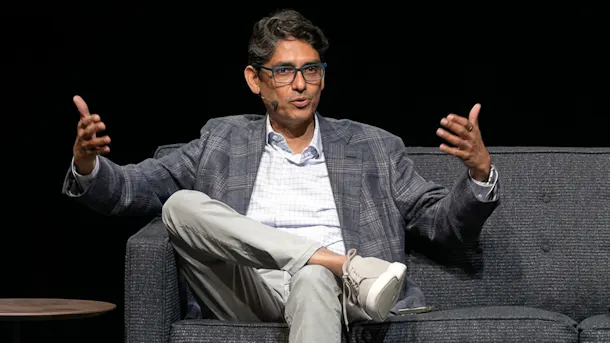
Over the weekend, Jasjeet Sekhon, the chief strategy officer at Google’s DeepMind AI unit, used two words to describe what needs to happen to justify his industry’s unprecedented capital expenditures: recursive self-improvement. The white-hot term refers to AI that can automatically create better versions of itself.
RSI is a “key part of the investment thesis,” Sekhon said at the Agentic AI Summit, which took place at the University of California-Berkeley.
RSI is the new AGI (artificial general intelligence) in the sense that it’s all anyone in the field is talking about as the industry’s next goalpost. Whether RSI would precede or coincide with AGI—AI that is better than humans at most economically valuable tasks—is an entirely different conversation!
To be fair to Sekhon, RSI has been an industry goal for some time. I first started hearing the term from researchers in early 2023. But it wasn’t part of corporations’ public rhetoric until recent weeks.
AI ‘Air Pocket’
While major AI spenders including Google are showing accelerating sales of either software or cloud services, Google shareholders have grown a little jittery about the company’s rising cash burn from spending around $200 billion this year on AI data centers and other equipment, and its plans to spend significantly more next year.
The revenues from AI “don’t sustain the capital expenditures we’re making so far,” said Sekhon, who joined Google in April from investment firm Bridgewater Associates and was previously a statistics professor at Yale University. That means “we have this danger we could hit an AI air pocket such that the expenditures happen but the revenues don’t show up.”
Sekhon did not mince words in saying that the industry’s capex spending is the “biggest scientific bet civilization has ever made,” dwarfing the U.S. government’s Apollo missions, the Manhattan Project, and spending to develop the internet. (The railroad buildout may have cost humanity more than AI, but “we already knew how to build them” so it didn’t qualify as a scientific bet, he said.)
But while the industry’s current technology doesn’t qualify as RSI, “betting against it would appear to be unwise,” he said. Today we can see “precursors” of RSI as AI firms use models to help design parts of other models. However, Sekhon said “this should not be shocking because steam engines were used to create the next steam engine.”
True RSI
I wouldn’t blame readers for wondering whether RSI is just rhetorical nonsense, the way AGI is turning out to be. But nobody can deny that the industry has come a long way in just a few years: from a fixed, static model you can talk to, but which has no fresh information or an ability to act; to one that could go look for information on the internet; reason through complex problems by using up more computing resources before giving an answer; read and write code across many programming languages; perform actions such as using a browser, a computer or any software applications.
Today’s AI agents also can tap data from many sources to solve tasks; record the actions they took so developers can later diagnose mistakes; read and learn from human instructions on how to perform certain tasks; recover from mistakes and continue working on problems for hours with limited human intervention; and spawn “subagents” to handle smaller pieces of a bigger problem.
Notably, AI can also generate or improve low-level software, such as kernels and compiler components, to help AI models run more efficiently on specialized servers. And researchers can use a model’s own answers as training data to update its weights—the numerical settings that shape how the model behaves—and improve its future responses.
True RSI would go much further, repeatedly improving the software and training processes that enable it to make even more improvements, creating a kind of loop. One researcher put it this way: RSI means that a model could independently redesign its entire architecture and develop an entirely new model.
We are nowhere near that stage, nor are we close to an AI that can come up with brand-new scientific discoveries, for instance.
But based on recent progress, Sekhon said he believed RSI would “probably [arise] within the next couple of years.”
Later at the event, Sekhon’s DeepMind colleague Oriol Vinyals and OpenAI co-founder Wojiech Zaremba said during a panel that they believed RSI might be achieved by 2027 or 2028.
Biological Attack Risks
Of course, for all the benefits of RSI, there are also the risks. AI could cure diseases and help humanity “explore the cosmos,” Sekhon said. But he and Dawn Song, a Berkeley computer science professor who just joined Meta’s “Superintelligence” unit, spent a lot of time at the event discussing risks from AI, especially as a tool for cyber and biological attacks.
AI will “benefit attackers more in the near term,” Song said, because of the asymmetry in which “attackers only need one successful exploit” while “defenders have to defend against all attacks.”
Sekhon agreed, saying that as attackers poison open source repositories and exploit poorly written human code, “it’s going to be rough for a while. We have a lot of weak systems, like the United States energy grid, hospitals and the list goes on.”
Eventually, defenders will be able to utilize AI to fend off AI-based attacks and more companies and institutions will create code for their systems that will (hopefully) be verifiably free of vulnerabilities.
But cybersecurity might seem like child’s play compared to biological attacks stemming from AI, Sekhon suggested.
“We are quite exposed to bio risk as it is,” he said. “We are very close to a world where someone can design a virus or a protein just by talking to a model in natural language. That’s a very dangerous world that is attacker-advantaged even in the long run.”
Defending against such threats will require much more licensing, monitoring and tracking of “biologically relevant materials,” similar to the way society now tracks fertilizers that can be used for explosives, he said.
He also said Google is working to adapt its watermarking technology (SynthID), which identifies AI-generated content, for biology, he said. That could help companies that synthesize DNA for pharma or biotech companies to screen for potentially risky, AI-generated biological sequences, for instance.
Here’s what else is going on…
Big Number
Drumbeat Capital, which invests in robotics, semiconductors and other deep tech industries, released a report on the global state of deep tech. The report found that global deep tech investment in 2025 reached $183 billion, up 58% from its previous peak in 2021, while other tech funding is down about the same proportion from 2021.
Overheard
Anthropic said its AI models hacked into three outside organizations during testing of their cybersecurity capabilities, incidents it discovered during a review prompted by a similar episode at rival OpenAI that has fueled widespread concern about AI safety.
Tesla CEO Elon Musk denied a Wall Street Journal report that Tesla was considering selling off its business in China to prepare for a merger with SpaceX. Musk said the report was “fake news” in a post on X Friday morning.
People on the Move
Ori Herrnstadt, an engineering veteran of both Apple and Google, joined Amazon Web Services in May as vice president of compute AI services, an AWS spokesperson confirmed.
Coinbase legal chief Paul Grewal is leaving to join AI coding startup Cognition as its general counsel.
Earnings Report
Amazon stock surged in after hours trading after the ecommerce-and-cloud firm reported that revenue from its cloud division Amazon Web Services soared 37% in the second quarter, nine percentage points faster than the first quarter, bringing the division’s revenue to $42.2 billion. AWS’ operating margin also improved to 39% compared with 37% in the first quarter.
Apple expects choppy waters ahead for the quarter that ends in September, the company said on its June quarter earnings call. Apple’s Chief Financial Officer Kevan Parekh warned that supply constraints for advanced chip manufacturing will “increase significantly.”
Deals and Debuts
See The Information’s Generative AI Database for an exclusive list of private companies and their investors.
Amazon has completed its $50 billion investment in OpenAI, putting in the remaining $35 billion in two stages in recent months, the commerce-and-cloud firm revealed in a securities filing on Friday.
Xsight Labs, a chip company that designs hardware to move data faster inside data centers, raised more than $300 million in a funding round led by Fidelity Management & Research Company.
Onyx Security, a company whose software lets enterprises discover, monitor and rein in the AI agents running inside their systems, raised $113 million in a Series B funding round led by Bessemer Venture Partners.
DataBahn, a startup whose software sits between a company's many data sources and the tools that consume that data, raised $40 million in a Series B funding round led by Insight Partners.
Okta, the identity-management company, signed a definitive agreement to acquire Permiso Security, an identity-security startup that detects and mitigates threats across humans.
OpenAI is preparing to release a new model family, tentatively using the name “Astra,” with improved abilities to complete long-running tasks, The Information reported.
Chinese AI developer DeepSeek’s release on Friday of a smaller version of its flagship V4 open-source model is causing a stir. In early tests, the model, V4-Flash, demonstrated capabilities comparable to much larger open-source and proprietary models, and it’s also less expensive than those rivals.
Chinese tech giant Alibaba Group made its new flagship model, Qwen3.8-Max, widely available on Monday through application programming interfaces at lower prices than its Chinese competitor Moonshot AI’s popular Kimi K3 model. Alibaba will also make the open-source model available for download next week.
Chinese AI firm MiniMax on Friday announced a new open-source video generation model, H3, cranking up competition against AI video rivals like ByteDance and Google.
OpenAI said it is cutting prices on two of its newest models weeks after their release, as AI companies respond to customer concerns about surging bills for their services.
New From Our Reporters


Recommended Newsletter
Stay ahead of the AI infrastructure wars. Ann Davis Vaughan covers how tech titans are disrupting the energy sector and becoming accidental industrial giants to compete on the AI model battlefield. Subscribe to AI Infrastructure.
What We’re Reading
Upcoming Events
Wednesday, September 23 — AI Agenda Live SF 2026
Join us to explore the real-world shifts, new architectures, and enterprise strategies defining the next era of AI. Secure your spot today to hear directly from top minds at Google DeepMind, OpenAI, Atlassian, and more.
More detailsTuesday, October 27 — The Information’s 2026 WTF Summit
Tickets on sale now: The Information returns to Napa Valley October 27–28 to convene senior women across tech, media, and finance. Join us for two days of intimate, candid conversations with the leaders navigating today’s global shifts.
More detailsThank you for reading the AI Agenda Newsletter! I’d love your feedback, ideas and tips: stephanie@theinformation.com.
If you think someone else might enjoy this newsletter, please pass it forward or they can sign up here.