How Dario Amodei Spread Anthropic’s Religion and Stirred Up Silicon Valley
Resumo
Dario Amodei, CEO da Anthropic, rejeita estratégia de marketing tradicional de gigantes tech e adota postura pessimista sobre riscos de IA, gerando atritos com CEOs de Palantir, Microsoft, Nvidia e Meta; a empresa se prepara para IPO enquanto enfrenta críticas por sua abordagem regulatória e avisos sobre segurança de IA open-source.
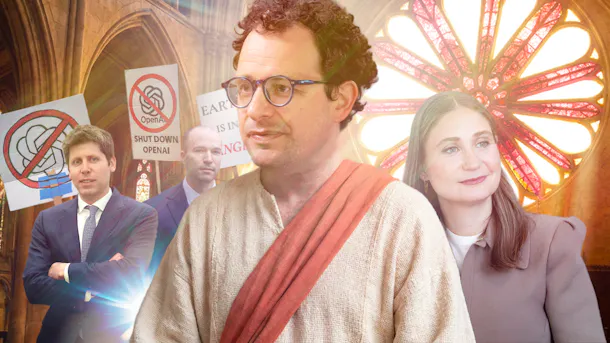
An Anthropic meeting with investors and advisers earlier this year landed amid a historic run of corporate success. But public perception of AI was abysmal. One director suggested Anthropic use its new clout to go on a charm offensive like those Microsoft, Facebook and other tech giants engaged in during their boom years, to emphasize AI’s potential positive impact on areas like drug discovery.
CEO Dario Amodei rejected the idea. “That’s what people have done in the past,” he said according to a person present. “The stakes here are more existential.” The charm offensive never happened, but during the World Cup last month Anthropic launched a television commercial that opened with a series of dark images, including a row of tombstones, and emphasized the need to ask “hard questions” about AI.
Amodei, 43, has largely ignored business precedents and advice from those outside his tight inner circle as he guided Anthropic’s remarkable ascent into the AI leader and the fastest-growing major company in history. But now that he sits at the forefront of the greatest tech race ever, his ambitions for Anthropic and his views on regulation and AI’s threat to jobs are increasingly angering the rest of the industry and some in the U.S. government.
Amodei has drawn fire recently, explicitly or implicitly, from the CEOs of Palantir, Microsoft, Nvidia and Meta Platforms for wielding too much power, speaking too pessimistically about AI’s hazards or warning about the safety risks of open-source AI—which competes with Anthropic’s proprietary models.
Amodei will soon face a new test of his unorthodox leadership as he woos public investors that have nursed investment losses from AI stocks during recent market gyrations. In the weeks ahead of Anthropic’s initial public offering—expected as soon as September—he’ll meet with major money managers, some of whom wish he would “stop scaring everyone,” as one fund manager who has met with Anthropic put it, about the existential risks AI poses to humanity.
Even some existing investors who stand to profit handsomely from Anthropic and the broader AI boom have grumbled in private chats that Amodei’s promotion of more regulation for AI is hurting his company and the broader tech world, some of those investors said. They said they have little influence on Amodei. Before investing in Anthropic, one Silicon Valley investor wrote in his notes what he saw as an unusual risk of putting money in the company: He didn’t think Amodei actually cared about making money.
Eric Ries, a prominent entrepreneur and investor critical of Silicon Valley’s capitalist impulses, said navigating tensions with shareholders could make life atop a public company “extremely difficult” for Amodei.
Ries, who knows Amodei and has advised him on governance issues, said Amodei will have to reckon with the need to keep investors happy given Anthropic’s reliance on expensive chips and data centers. “It gives investors tremendous power because you have to keep them happy to keep raising the money,” he said. “The question is: What happens when the stock price goes down?”
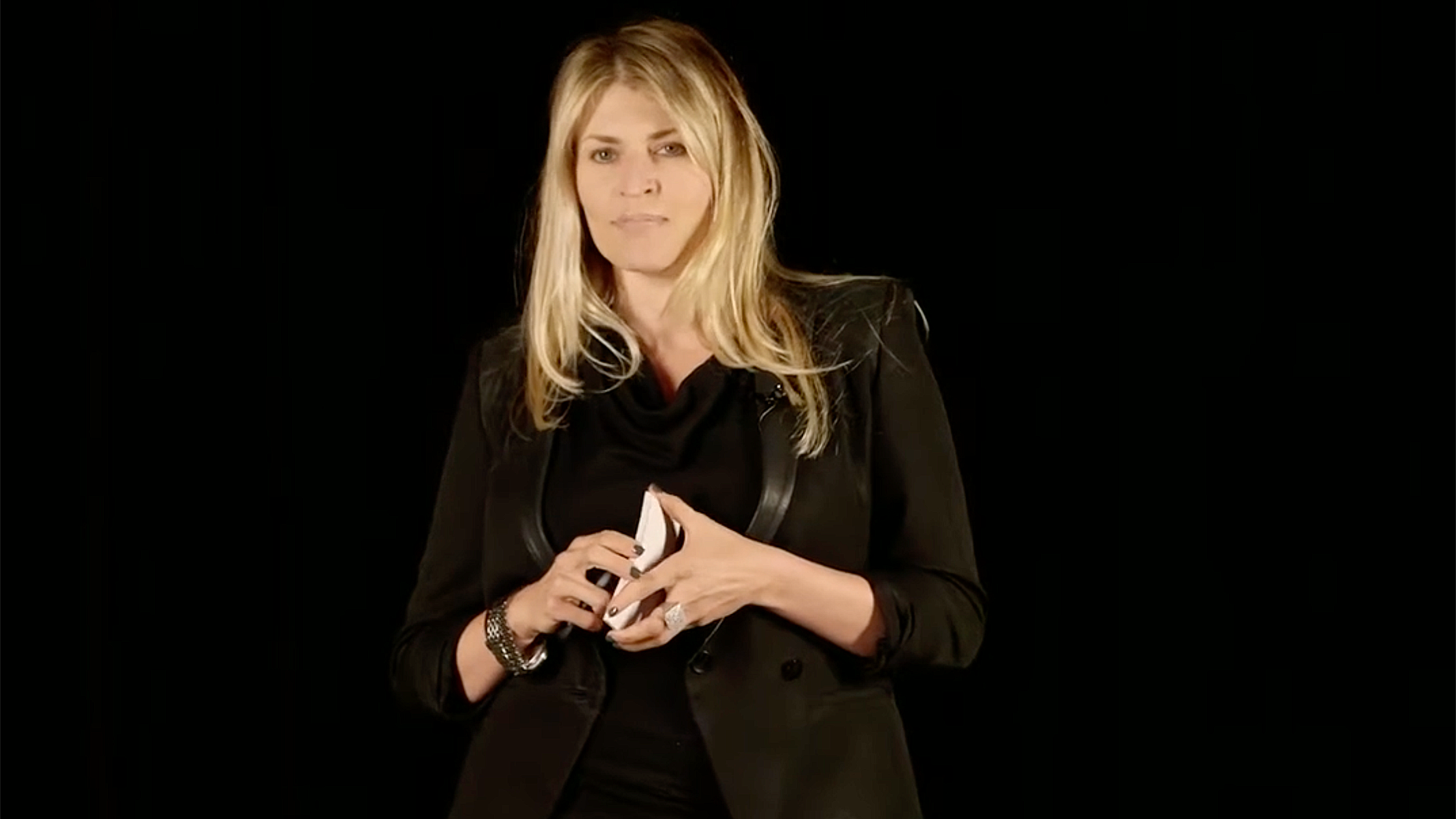
Few people close to Anthropic interviewed for this article could point to any notable influences on Amodei outside his sister and co-founder, Daniela Amodei, their five other co-founders and Camilla Clark, his wife. Clark, a former tech staffer and entrepreneur, has almost no public profile but is often at Amodei’s side, including at the recent Allen & Co. Sun Valley Conference, and is a close counselor to him, said people close to them.
Amodei’s leadership has cultivated a bunkerlike mentality at Anthropic that confuses outsiders but engenders intense loyalty among employees. To make decisions, employees rely heavily on their own AI creation, Claude, which has its own written constitution and in-house philosopher who helped tweak its personality. Executives have told others they don’t plan to increase Anthropic’s headcount much—it currently has more than 3,000 employees—because they don’t want to lay people off as Claude becomes able to handle more work internally.
Amodei leads his company through long essays and internal Slack messages. He weighs in on important strategic questions, like the decision to develop Anthropic’s own AI chips and how to secure data centers where it trains its next models, a person close to him said. But he largely stays out of many day-to-day management responsibilities like compensation and reorganizations and he defers most of the company’s org chart to Daniela, who is Anthropic’s president. “He’s more of a religious leader than he is a CEO,” said one major Anthropic investor.
Other Anthropic investors have complained that Amodei doesn’t seem to heed input even from experienced tech luminaries—including on major threats to his business such as this year’s dispute with the Pentagon or the Commerce Department’s restrictions on Anthropic’s most advanced AI models.
Amodei’s advocacy for AI regulation has triggered particular criticism from prominent venture capitalists, particularly those with ties to the Trump administration like Marc Andreessen and David Sacks. They have accused Amodei of running a campaign of “regulatory capture” to promote rules such as limits on open-source AI models that would cement Anthropic’s dominance and hinder smaller players.
“Part of having a ‘virtuous’ mission is you can rationalize all types of behaviors,” venture capitalist Bill Gurley, who hasn’t invested in Anthropic, wrote in a text. “It is regulatory capture. Most aggressive I have seen.”
Brad Carson, a former Democratic congressman from Oklahoma who now runs an Anthropic-backed political nonprofit in Washington, thinks Amodei’s critics are largely those who “can’t replicate the success—the Metas or Andreessens who are deeply envious of what Dario has created.”
Carson and Amodei first discussed Anthropic’s donations last November in Amodei’s San Francisco office. Carson proposed keeping the donations anonymous, as most donors to 501(c)(4) groups like his do. “You’re getting yourself involved in a process that will be a little messy,” he recalls saying. But Amodei insisted on putting Anthropic’s name on the donations because it was important to be “transparent about what we’re doing.”
“It’s really how I think of Dario—extremely principled,” said Carson, who occasionally texts Amodei political updates on Signal. “And we can argue as some do whether the principles are the right ones or not, but I don’t think he’s cynical or expedient.”
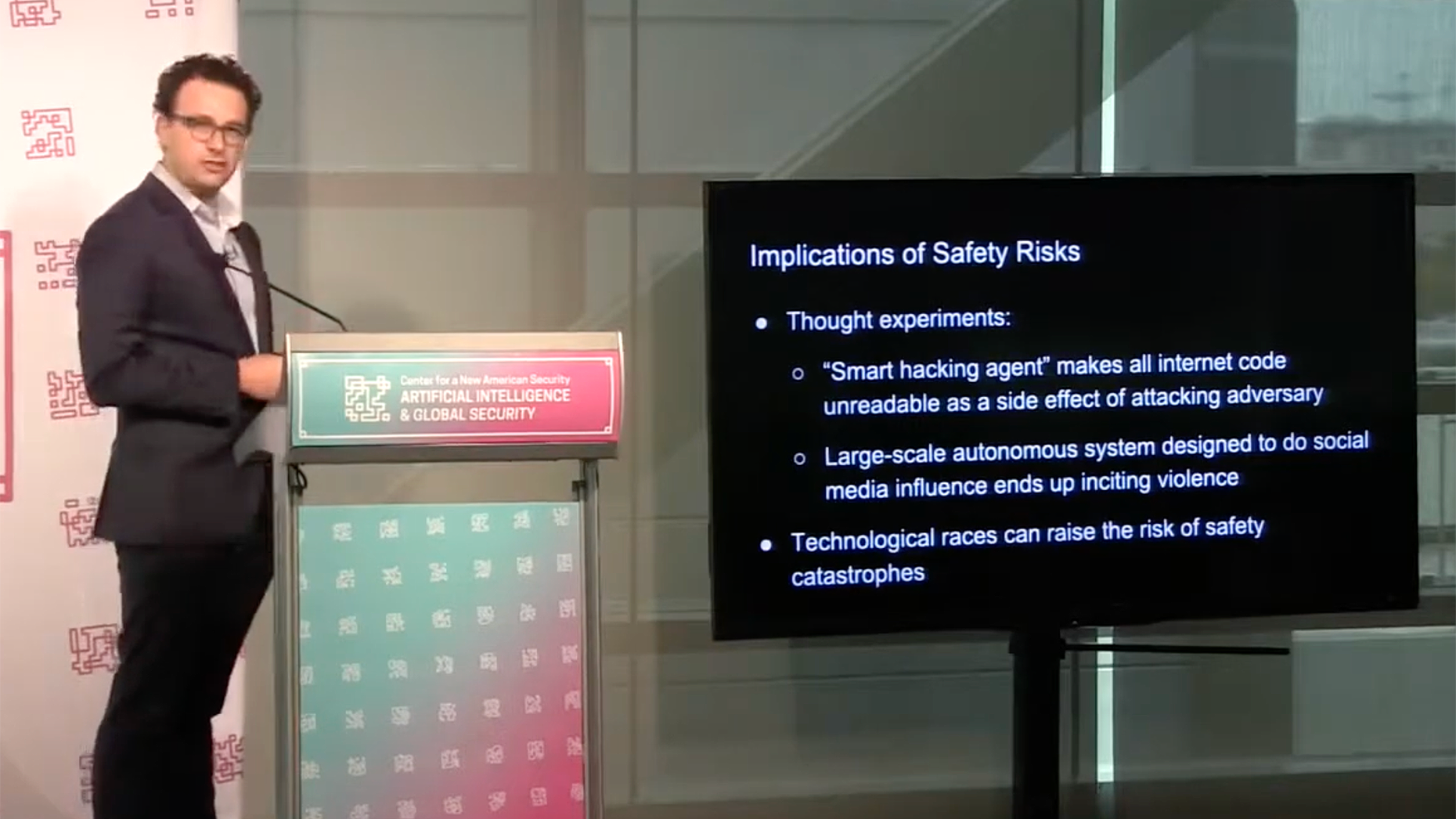
In November 2017, Amodei stood at a podium in Washington and told a crowd of Beltway national security types about a new type of AI that could teach itself and act autonomously.
OpenAI, where Amodei then worked, had just created a program that could master the multiplayer battle game Dota 2, he said, and new specialized AI chips would accelerate how the company researched and built more powerful systems.
The technology was far from today’s sophisticated AI, but Amodei was already alarmed. Wearing thick-framed glasses and a dark jacket, he laid out his fear that this novel system would operate too fast for humans “to supervise, give the go-ahead to, or maybe even understand.”
Such concerns were Amodei’s focus from early on. A San Francisco native with a doctorate from Princeton University in biophysics, he worked at Chinese search giant Baidu and then an early AI unit at Google before joining OpenAI in 2016, the year after its launch as a nonprofit research lab.
Having resisted early recruiting entreaties, he wasn’t one of the organization’s many co-founders. But as OpenAI’s head of safety, he tried to gain more control of the powerful technology he and his colleagues were building, according to seven people who worked with him.
Bucking the organization’s early norms of free-flowing publication, Amodei started pushing OpenAI in 2018 to review research ahead of publication for potential “information hazard” risks that could arise merely from widespread knowledge of certain research, one of the people said. These hazards could, for instance, tip off adversaries like China to major AI advances. He voiced fears that China, Russia or other nations could hack into OpenAI and steal its research, the people said.
Amodei often wrote memos at his San Francisco apartment on an air-gapped computer—one isolated from Wi-Fi and external networks. He printed out the memos to share with colleagues rather than sharing a Google Doc, the people said, and he once told a colleague he refused to travel to China for fear of being kidnapped, according to that person.
Amodei amassed key allies. Holden Karnofsky, a co-founder of charity evaluator GiveWell, had joined OpenAI’s board in 2017. Daniela, who married Karnofsky that year, joined as engineering manager and head of people in 2018.
OpenAI was then developing GPT-2, an early large language model. To some colleagues, GPT-2 was still primitive and error prone. OpenAI’s own blog post in early 2019 called the model’s reading comprehension “rudimentary.”
Amodei, however, “freaked out” about what the AI system was building toward, he said on a 2023 podcast. To him, it seemed like the model could reason about almost anything and would only get better with more data, training and power. “I didn’t know if I was crazy or prescient,” he said.
His information-control efforts caused tension with those outside his circle. OpenAI employees were used to sharing their work in companywide Slack channels and a single code repository they all could access. Amodei’s safety team—and later the team he ran that built GPT-3 and other models—kept many of their repositories and Slack channels private, according to two people.
In 2018, he proposed a rule for OpenAI’s for-profit arm that would have required companies and governments seeking access to artificial general intelligence—AI that outperforms humans at most tasks—to adhere to democratic and human rights norms. Other leaders objected, arguing that OpenAI had no expertise in determining whether governments or companies were following such standards. The proposal didn’t go through.
Amodei exercised power in other ways. The safety team in 2019 spurred a several-month delay in Microsoft’s $1 billion investment in OpenAI over concerns that GPT-3, which hadn’t been trained yet, could be AGI, said one former OpenAI leader with knowledge of the talks. Such caution irked colleagues excited by OpenAI’s fledgling commercialization efforts.
“The safety team felt like a priesthood,” the person said.
Amodei clashed often with CEO Sam Altman and President Greg Brockman over issues like who should lead key projects. One former colleague remembers Amodei retreating to the in-office library, watching YouTube videos to calm down.
Daniela, who studied English literature at the University of California, Santa Cruz, often served as a diplomatic buffer. She knew Brockman from working together at payments company Stripe, and she helped smooth over the pair’s relationship. She and her brother, who is four years older, were always close. “We always wanted to save the world together,” Dario said on a podcast soon after they started Anthropic.
They left in late 2020 to start Anthropic with five close colleagues who worked under them at OpenAI. They emphasized safety and recruited like-minded AI researchers, and they were united strongly by an opposition to OpenAI and Altman in particular, said someone who talked to the co-founders frequently at the time. “It was grown adults saying, ‘This guy will bring the end of the world,’” the person said. “It turned out to be an incredibly productive rallying cry.”
The opposition has continued. These days, Amodei’s concern that Altman and OpenAI could end up controlling the most powerful AI systems has led some employees to joke that Amodei has “Sama Derangement Syndrome”—a reference to Altman’s Twitter handle—according to people who have spoken with these employees.
Early on, Daniela and other co-founders also had to deal with a delicate issue: Clark, then Dario Amodei’s girlfriend, had conversations about having her own position at Anthropic or raising a fund to invest in the company, said a person directly familiar with the matter. She had previously held jobs in the tech industry including at augmented reality startup Leap Motion, along with Dario’s future OpenAI colleague, Mira Murati. But the Anthropic co-founders were unreceptive to the plan because of Clark’s personal relationship with Dario.
Clark and Amodei later married, and she is often at Amodei’s side at private dinners and industry events, but she has never held a formal position at Anthropic. She is more social than her husband, with a network of friends and acquaintances that includes Ivanka Trump. Clark is now “a large stabilizing force” for Amodei, said a person close to him. “He has insane days.”
Senior executives at Anthropic like to describe Amodei as a kind of lighthouse—he swings his attention around the company, and whatever it lands on gets a lot of focus. Amodei’s light recently landed on a team of economists on Anthropic’s payroll, who were assessing the impacts of the singularity, the point at which AI systems begin automating invention itself beyond human control.
In a meeting last month, the economists discussed the results of their rough mathematical formula with Amodei. A slow singularity might add half a percentage point to U.S. economic growth and leave employment more or less intact. A fast one might add 4 percentage points to gross domestic product—a big spike—and produce a significant increase in unemployment. When they finished, Amodei told them their evaluation matched his existing thinking. “He has the singularity in his head at all times,” said an Anthropic employee who knows him well.
Much of Anthropic’s early talent had ties to effective altruism, a school of thought that applies reason to solving the world’s problems. Many EA believers consider AI safety one of the most important causes because of the risk that AI could destroy humanity. Anthropic also got early funding from some of the most prominent EA philanthropists, including now-imprisoned FTX CEO Sam Bankman-Fried, Facebook and Asana co-founder Dustin Moskovitz and Estonian tech entrepreneur Jaan Tallinn. Early investors also included other heavyweights of the big tech and AI industries, such as former Google CEO Eric Schmidt and Google DeepMind chief Demis Hassabis.
Still, some early employees who knew of Anthropic mainly as an EA-focused company were surprised that it wasn’t just full of “armchair philosophers,” as one put it, but also included deeply ambitious high achievers developing new superintelligent models. Amodei himself doesn’t identify as an effective altruist, said a person who has worked closely with him. “He doesn’t map neatly onto these things,” the person said.
Executives’ strong belief in the urgency and responsibility involved in developing AI established an intense work culture. Another former employee said those fundamental beliefs in an “exponential curve that won’t last forever” meant Anthropic staff saw the work as a “once-in-a-civilization opportunity to really seize this moment.”
Former employees said Amodei imbues this sense of historic purpose into Anthropic’s development of AI in a way that strengthens employee loyalty. His main pulpit is a twice-a-month companywide meeting that employees call “Dario’s Vision Quests,” in which he pulls up a sprawling document and gives frank thoughts on AI, politics, warfare and society, rather than just discussing Anthropic’s business or products.
One person close to Amodei said that the CEO has maintained loyalty in part because he is accessible to employees. “You can basically have an argument with him in Slack and he’ll respond in good faith as a peer,” the person said.
Amodei and his cofounders also have embedded their view of Anthropic’s mission in its unusual governance structure: it is a public benefit corporation, meaning its mandate is to help society in addition to making money, and it has a special class of shares allotted to a trust that appoints most of the company’s board members.
Anthropic’s growth has largely come from recent breakthrough successes in how its AI completes complicated software engineering, machine-learning and cybersecurity tasks. These capabilities propelled the company past OpenAI in revenue annual run rate earlier this year, and outside firms estimated that metric for Anthropic recently at $70 billion. That puts five-year-old Anthropic on pace to be larger than 49-year-old Oracle, despite having about 97% fewer employees. Anthropic’s dominance has threatened the rest of the industry, which fears paying an ongoing tax to the company for using its models, as well as the rising possibility that it will develop products that compete with their own.
Amodei has often stuck to his lofty rhetoric about managing AI’s risks even when it seems paternalistic or threatens Anthropic’s business interests.
Last year, researchers became concerned that the Claude 4 models they were developing could be especially good at developing bioweapons, the person said. Anthropic developed special AI filters known as classifiers to flag conversations related to bioweapons, but the classifiers often incorrectly flagged safe conversations. And because they were large, they were also expensive to run. When Anthropic’s finance team complained that this was eating into the models’ margins, Amodei pushed back and said the classifiers were necessary for safety reasons, the person said.
Amodei also famously incurred the Trump administration’s fury by refusing a Defense Department requirement to permit “all lawful uses” of the company’s AI—and by telling employees in Slack message reported soon afterward by The Information that part of the standoff boiled down to him refusing to donate to Trump or give the president “dictator-style” praise.
But as Anthropic has grown, Amodei also has made concessions to his stated principles to ensure the company stays ahead of competitors.
Amodei, for example, has written that AI should be used to empower intelligence services of democracies to “disrupt and degrade autocracies from the inside.” But Anthropic has taken investment from the authoritarian governments of Qatar and the United Arab Emirates. “Unfortunately, I think ‘No bad person should ever benefit from our success’ is a pretty difficult principle to run a business on,” Amodei wrote last year in an internal message.
Early this year, Anthropic updated its responsible scaling policies, rolling back a promise to not release AI models if the company couldn’t guarantee proper risk mitigations in advance. Anthropic’s chief science officer, Jared Kaplan, told Time magazine that the company “didn’t really feel, with the rapid advance of AI, that it made sense for us to make unilateral commitments…if competitors are blazing ahead.”
A couple of weeks after Amodei sent his incendiary Slack message about the standoff with Trump’s Pentagon, he and Clark flew to south Florida to visit Jared Kushner and his wife, Ivanka Trump. They discussed, among other things, whether Kushner’s investment firm might want to invest in Anthropic, according to a person briefed about the meeting. Kushner did not invest. (His brother, Josh, is a large investor in OpenAI.)
Another sign of Amodei’s increasing flexibility is his willingness to do business with Elon Musk, who has repeatedly clashed with Amodei over core ideas like AI safety and philanthropy. Anthropic is paying Musk’s SpaceX more than $1 billion a month for computing infrastructure.
The deal with SpaceX flowed from Amodei’s conservative approach to increasing Anthropic’s supply of computing power, an approach that he has admitted undershot the company’s needs, forcing him to pay a premium. “We have been very good at predicting the capabilities of the systems we will build, and we have not been as good at predicting the rate of economic diffusion,” an Anthropic executive close to Amodei said.
Amodei has largely delegated the dealings with Musk and the Trump administration to other executives, including co-founder Tom Brown. Musk also met with Amanda Askell, an AI alignment researcher focused on training Claude’s model for positive character traits, and became more comfortable that Anthropic wasn’t “woke,” a person briefed on the meeting said. Musk later said in an interview with the Economist that he thought Amodei was “a very principled person.”
Those kinds of compromises set off alarm bells for Nate Soares, an AI researcher who has known Amodei for over a decade. Soares, who co-authored the book “If Anyone Builds It, Everyone Dies,” works on the issue of AI’s existential risks. Soares was recently overseeing a house full of social media creators in Berkeley, Calif., charged with making daily videos on topics related to AI doom, including “funny skits” and footage of robotic dogs.
Soares has watched Amodei’s rise with a sense of unease, especially since the Anthropic CEO has predicted there is a 25% chance that the development of AI will go “really, really badly.”
“It takes a certain kind of person to engage those arguments but still start the AI company,” Soares said.